
Training course "Enhancing AI skills for learning and scientific research for students"
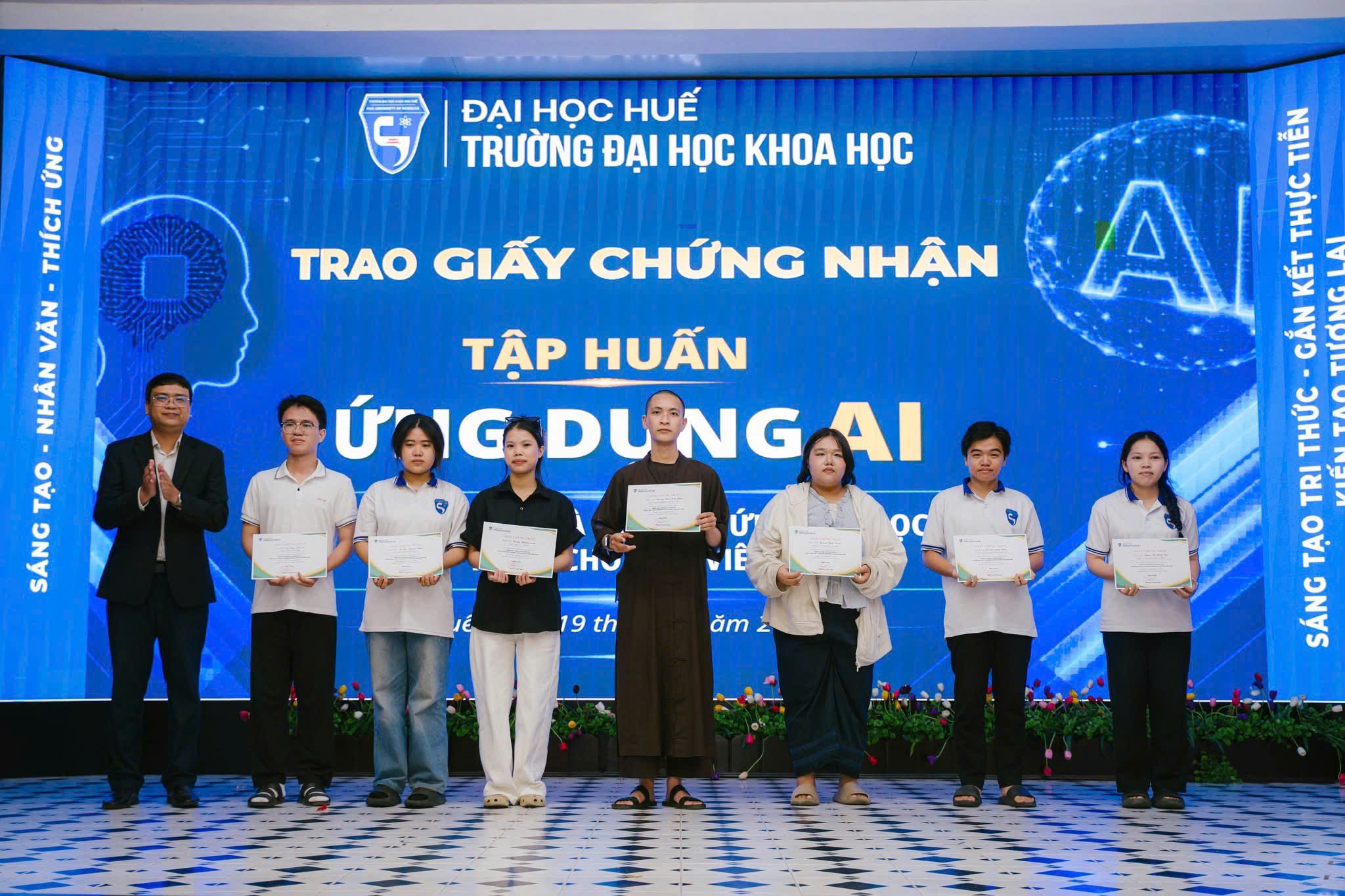
On 19 May, the University of Sciences, Hue University, successfully organized the training course "Enhancing AI skills for learning and scientific research for students". The program attracted the enthusiastic participation of students from various faculties, providing practical knowledge and skills in artificial intelligence (AI) in the context of digital transformation in education.
The opening session was attended by: Dr. Phan Tuan Anh, Vice Rector; representatives of the leadership of the Office for Science, Technology, International Relations and Library services and the Office for Training and Student Affairs; Dr. Nguyen Dang Binh, Head of the Computer Science Department, Faculty of Information Technology – the instructor of the course; and more than 150 participating students.
Speaking at the training session, Dr. Phan Tuan Anh emphasized the importance of mastering technology, particularly artificial intelligence, to help students optimize their learning process and improve the quality of their scientific research work.
The training program consisted of 2 modules:
Module 1: AI Assistants in the Learning Process
Introduction to common types of AI and the impact of the "AI tsunami wave" on the future labor market.
Guidance on basic and effective "Prompt Engineering" skills.
Application of AI in summarizing lectures, explaining complex concepts, planning exam revision, and automating the creation of flashcards/mind maps.
Module 2: AI Applications in Scientific Research
Optimizing the search for and evaluation of reference materials.
Support for processing, analyzing, and visualizing data.
Support for structuring scientific paper outlines and refining academic writing style.
Important warning: the expert also specifically noted the limitations of AI for students, such as the phenomenon of "hallucination," as well as copyright and ethical issues in research.
A highlight of the program was the hands-on demonstration (live demo) and discussion (Q&A) session. Dr. Nguyen Dang Binh directly demonstrated a real case study: from the initial stage of idea generation to completing a full scientific research outline with the support of AI.
In the afternoon of the same day, students had the opportunity to practice directly on computers in room E5.05. There, students personally worked with AI tools and solved practical case-study exercises under the close guidance of a team of teaching assistants.
The organizing committee acknowledged and highly appreciated the students' eagerness to learn and their serious attitude. The active engagement and effort to acquire new knowledge demonstrated the students' aspiration for personal development in the technology era.
At the conclusion of the program, the University held a closing ceremony and awarded certificates of completion to the students. The knowledge and skills gained are expected to become useful assets, helping students effectively apply AI to their studies, scientific research, and future career development.